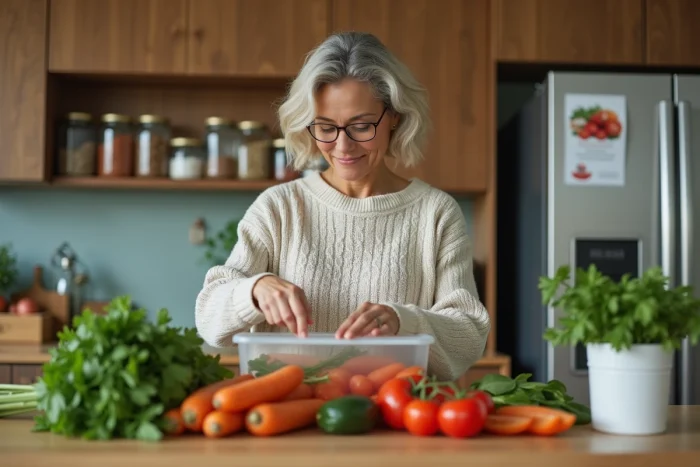
An opened yogurt sitting in the fridge often lasts several days after the printed date, while a salad, even if well cared for, doesn’t survive two evenings. The National Agency for Health Security sets the bar at 4 °C for our refrigerators, but few appliances actually reach that low: the norm is more like 6 °C. Meanwhile, carrot or leek peels, thrown away without regret, could be turned into flavorful and nutrient-rich broths. Every year, France sends nearly 30 kg of food per person to the bin. Many of these foods could have ended up on a plate, not in a trash can.
Why do so many foods end up in the trash? Understanding the causes of waste at home
Food waste is not just a number. It’s a chasm that swallows money and natural resources, at home and elsewhere. Nearly 10 million tons of still consumable food end up in landfills in France each year. The root cause: daily habits that are often mechanical, turning the refrigerator into a graveyard for forgotten or poorly stored products.
At the forefront: us, the consumers. The statistics are clear: nearly half of food losses occur in the domestic sphere. Shopping without preparation, purchases driven by promotions, ignorance of actual needs… As a result, cupboards overflow with products that will never see a plate. The dates displayed on packaging create confusion. Too often, a DDM (minimum durability date) is interpreted as a fateful date, while beyond that, the product generally remains good. Conversely, the DLC (use-by date) leaves no margin for error for fresh foods.
To limit the damage, sometimes it just takes adjusting a few habits: adapting quantities to appetites, checking the fridge contents before shopping, arranging products so that those that expire the fastest are consumed first. Leftovers, on the other hand, are undervalued: they end up in the trash or, at best, in the compost bin, while they could inspire new meals. Freezing, repurposing, transforming… These actions remain largely underutilized, despite their effectiveness.
There are also technical solutions that make a difference. For example, vacuum preservation, detailed on jeconserve.fr in the “Best Vacuum Sealer 2026 – Test and Comparison” section, helps keep food fresh longer and reduces the frequency of losses. Fighting waste starts on the plate, but also involves better organization and a fine understanding of the mechanisms at play in each household.
How to extend the freshness of your food: simple and effective tips to adopt daily
Optimizing food preservation is primarily a matter of organization and vigilance. The refrigerator remains the centerpiece: for most fresh products, aim for a temperature between 0 and 4 °C. Raw meats should be placed at the bottom of the fridge to avoid any contamination. Dairy products prefer the center, protected from temperature fluctuations. As for fruits and vegetables, not all have the same requirements: some do not tolerate cold well and deserve a specific bin, while others thrive in it.
- Always check the dates: the DLC leaves no margin for fresh products, while the DDM simply indicates a loss of flavor or texture, with no real danger.
- Consider labeling your containers: note the purchase or freezing date, so you don’t lose track in the fridge or freezer.
- Opt for airtight containers, made of glass or stainless steel, to preserve freshness and prevent the spread of odors. These materials are also more durable than plastic.
Bread, on the other hand, dries out quickly in the open air. Store it in a cloth bag or a box, away from the cold. Some fruits, like bananas, tomatoes, and avocados, prefer room temperature, while apples and berries require the coolness of the fridge. When it comes to freezing, remember to portion leftovers before placing them at -17 to -15 °C: this way, you’ll avoid thawing too much at once and having to throw away the excess.
To vary your meals, there’s nothing stopping you from returning to tried-and-true techniques: fermentation, marinades, confits, or brining. These processes add value to food and push back the fateful date of waste. For those who want to go further, vacuum preservation, as presented on jeconserve.fr, is a reliable ally for keeping freshness and limiting waste volume.
Ideas for using leftovers and transforming surpluses into new tasty meals
Who has never found a forgotten leftover at the back of the fridge? Yet, every uneaten portion can become the base of a new dish. Take stale bread: sliced and baked, it turns into golden croutons ready to enhance a soup. Crumbled, it transforms into breadcrumbs for homemade gratins. Leftover meat or vegetables can be slipped into an improvised stuffing.
Cooked vegetables in excess? They can be added to an omelet, a quiche, or a soup blended with a bit of broth. Batch cooking also has its followers: cooking in advance, storing, assembling differently according to cravings, and freezing part to space out meals while preserving flavors.
- Recycle leftover fish into homemade rillettes, simply blended with cream cheese and some herbs.
- Add cooked pasta or rice to composed salads, with crunchy vegetables or seeds.
- Gather small bits of cheese and give them a second life in a gratin, a sauce, or a savory tart.
When truly nothing can be eaten anymore, consider composting. Organic waste then takes its place back in the natural cycle, lightening the trash and nourishing the soil. Less waste, more ideas: it’s as simple as that. Now, just imagine what each leftover in your fridge could become tomorrow, on your plate.