
A wireless switch consists of two distinct elements: a wall transmitter (the control that is manipulated) and a receiver connected to the electrical circuit of the light fixture. The transmitter communicates via radio frequency with the receiver, which eliminates the need to run cables through the walls. This physical separation between the control and the electrical connection radically changes the nature of the intervention depending on which component is being handled.
Receiver connected to 230 V: the part that raises questions
The majority of guides present the wireless switch as an installation without any work. This is true for the transmitter, which is fixed to the wall with adhesive or two screws. The receiver (or micromodule), on the other hand, requires direct handling of live conductors.
This micromodule is placed in a DCL box in the ceiling, in a junction box, or behind an existing switch. It is necessary to identify the phase, neutral, and lamp return, and then connect each wire to the corresponding terminal. A wiring error does not always cause a visible short circuit: it can damage the module or create a silent insulation fault.
Before any manipulation, the power must be cut at the circuit breaker of the concerned circuit and the absence of voltage must be checked with an appropriate tester. This point is non-negotiable, even for an experienced DIYer. To discover Inside Out in detail, the subject is also addressed from a practical perspective.
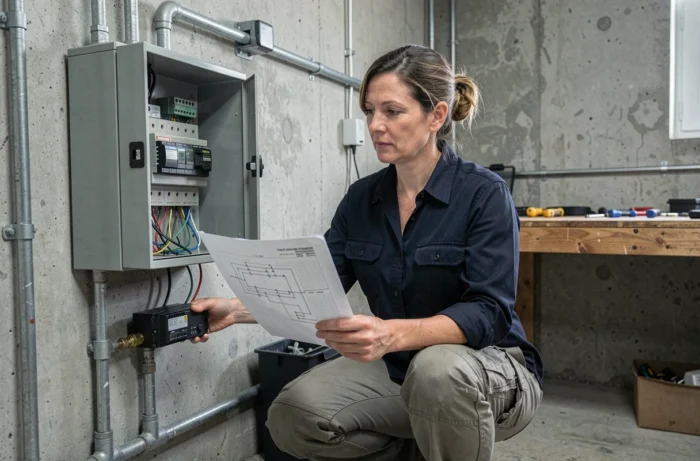
Load compatibility of the receiver: a neglected safety criterion
The receiver does not simply cut or restore a circuit. It manages a specific type of load, and not all receivers tolerate all lamps.
A module designed for a resistive load (traditional halogen bulb) may react poorly to an electronic load (LED with integrated driver). Symptoms range from flickering bulbs to overheating of the module. The technical data sheets from manufacturers mention different power limits depending on the type of load connected.
Before purchasing a kit, three points must be checked on the product sheet of the receiver:
- The maximum power allowed for resistive load and LED load, which often differ significantly
- The necessity or not of a neutral wire at the connection point (some modules work without neutral, others require it)
- The type of power supply for the transmitter: battery, kinetic energy, or wired connection
An electrician can identify these parameters in a few minutes. A layperson can do it too, provided they read the product manual and know the type of fixture installed in their home.
NF C 15-100 standard and existing installation
The NF C 15-100 standard governs electrical installations in new homes and major renovations. Its 2024 edition brought updates, particularly regarding fire safety and circuit sizing.
Adding a wireless switch to an existing installation does not trigger the obligation to bring the entire home up to current standards. The intervention remains isolated: a receiver is added to an already existing circuit. However, if the electrical panel or existing wiring shows visible defects (exposed wires, lack of grounding, unsuitable circuit breaker), installing the module will not correct anything.
A professional will spot these anomalies during their visit. A layperson opening a junction box for the first time does not always have the benchmarks to distinguish a healthy installation from a degraded one.
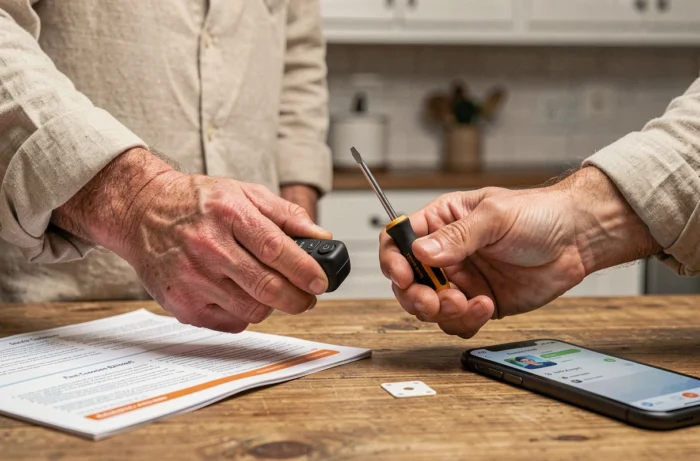
When an electrician becomes truly necessary
No legal obligation requires hiring a professional to install a simple switch in one’s own home. The question is framed differently: is the intervention within the capabilities of the person performing it?
Several situations make the intervention of an electrician preferable:
- The electrical panel does not have clear identification of circuits, complicating the identification of the correct circuit breaker
- The box in the ceiling contains more than three conductors or wires of non-standard colors
- The home dates back to before the 1990s and has never undergone electrical renovation
- The receiver needs to be installed in a confined space (low false ceiling, already full flush box)
In these cases, the risk is not so much electrocution (which can be controlled by cutting the power) but rather incorrect wiring creating a latent fault. A poorly wired module may function for weeks before causing a problem.
The case of an existing two-way switch
Adding a wireless switch to an existing two-way circuit is a common scenario. The wiring of a two-way switch uses travelers between two switches, and the receiver must fit into this scheme without disrupting it. Confusing the travelers with the lamp return is the most common mistake on specialized forums.
If the two-way switch scheme is understood and the wires are correctly identified, the installation remains accessible. Otherwise, an incorrect connection can render the entire circuit inoperative without any obvious external signs.
Choosing between DIY and professional intervention
For a simple circuit (a switch controlling a single light fixture), with a clearly marked panel and a recent home, the installation of the receiver remains accessible to a methodical DIYer. The kit manual provides the wiring diagram, and the operation takes less than an hour.
For a complex circuit, an older home, or uncertainty about the state of the wiring, consulting an electrician is not an unnecessary precaution. The cost of the intervention remains moderate compared to the risk of an undetected electrical fault. The real decision criterion is not the theoretical difficulty of the installation, but the ability to identify what is found behind the switch plate or in the fixture box.