
An ESP/ASR warning light that illuminates along with a loss of power almost always indicates a reduced mode activated by the engine control unit. The CAN bus network connects the ESP module to the ECU: as soon as an inconsistent signal is detected, the ECU limits the torque transmitted to the wheels. We will detail the precise technical mechanisms, the underestimated causes, and the diagnostic methodology that allows us to address this ESP ASR fault without randomly replacing parts.
Steering Angle Sensor: the silent failure that triggers reduced mode
The steering angle sensor is the component most often implicated in cases of ESP/ASR faults with simultaneous power loss. This sensor, located in the steering column, continuously transmits the steering wheel angle to the ESP control unit. When its value drifts or freezes, the ESP module interprets an inconsistency between the desired trajectory and the actual trajectory.
The engine control unit then receives an error message via the CAN bus and reduces the available torque. The driver experiences a noticeable loss of power, sometimes accompanied by jerks during acceleration.
In 2024, the European RAPEX (Safety Gate) system recorded several recall alerts concerning faulty steering angle sensors on SUVs from the Volkswagen group and Stellantis models. These recalls precisely document the scenario: persistent illumination of the ESP/ASR warning light, partial deactivation of the ESP, and reduced mode with power loss. Before any intervention, we recommend checking if your vehicle is subject to a manufacturer recall based on the EU Safety Gate.
Replacing the sensor itself is an accessible operation, but the procedure requires a recalibration of the midpoint using the diagnostic tool after installation. Without this step, the fault reappears immediately.
To better understand how to resolve an ESP ASR fault and power loss, it is essential to first isolate the exact error code before replacing anything.

Engine Reprogramming and Ethanol Box: an emerging cause of ESP ASR faults
Dealerships and repair networks have observed a significant increase in ESP/ASR faults related to ethanol boxes or non-homologated engine reprogramming in recent years. The mechanism is logical: Euro 6d and subsequent standards have made the control units much more sensitive to inconsistencies between the measured torque and the torque transmitted to other modules (ABS, ESP).
When a flex-fuel box modifies the injection times without the ESP control unit being informed of the actual mapping, the engine torque measured by the crankshaft sensor no longer corresponds to the torque expected by the stability module. The result: entry into reduced mode, ESP/ASR warning light illuminated, power limitation.
The professional magazine Décision Atelier and the AD Expert network have documented these cases in their technical files. The trap for the unsuspecting mechanic is to look for a wheel sensor or a mechanical problem when the cause is purely software-related.
Checks to perform after reprogramming
- Check the consistency between the injector mapping and the torque values expected by the ESP module, by reading real-time parameters on the diagnostic tool
- Verify that the ethanol box is homologated and that its installation has been updated in the vehicle registration document (FE mention in field P3)
- Clear the fault codes and then conduct a road test while recording the data: if the fault returns within the first few kilometers, the reprogramming is at fault
OBD2 Diagnosis of ESP ASR Fault: reading beyond the generic code
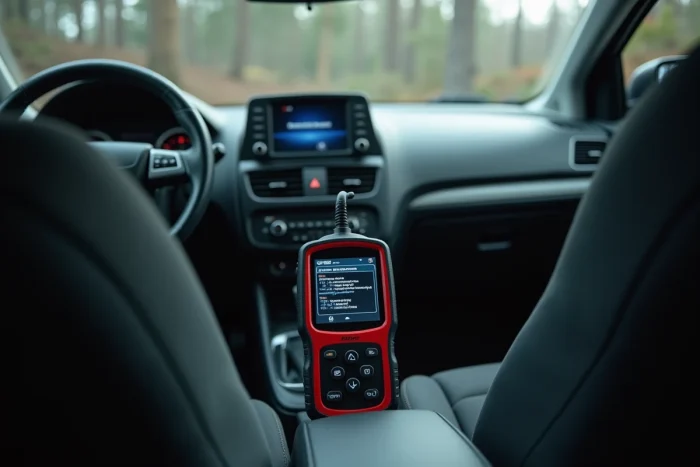
Connecting a basic OBD2 reader allows for retrieving a fault code, but generic P codes are not sufficient for an ESP/ASR fault. The stability system uses specific manufacturer codes (C or U) that only display with a tool compatible with the vehicle’s brand.
A C1288 code on a Stellantis vehicle points to the left rear wheel speed sensor. A U0126 code indicates a loss of communication between the ABS/ESP module and the engine control unit. With a generic reader, these codes remain invisible, and the diagnosis goes in circles.
Structured Diagnostic Methodology
We recommend proceeding in this order:
- Reading fault codes on all control units (engine, ABS/ESP, power steering) with a multi-brand or manufacturer-specific tool
- Analyzing the freeze frame data associated with the code: engine speed, vehicle speed, steering angle at the time of the fault
- Physically checking the wheel speed sensors (resistance, air gap, condition of the magnetic encoder) and the steering angle sensor
- Checking the integrity of the wiring harness and connectors, especially in wheel arch areas where corrosion is common
The freeze frame is the most underutilized data. If the fault consistently appears at low speed while turning, the angle sensor is the primary suspect. If the fault occurs above a certain speed, a wheel sensor or ABS signal issue is more likely.
ABS Wheel Speed Sensors: mechanical wear and corrosion
Wheel speed sensors remain the most frequently cited cause of ESP faults with power loss. Two technologies coexist: inductive sensors (passive) and Hall effect sensors (active). Inductive sensors generate a sinusoidal signal whose amplitude depends on the air gap with the toothed encoder. An air gap that is too large (bearing wear, accumulation of metal shavings) produces a weak signal that the ECU interprets as a wheel loss.
Hall effect sensors, powered by voltage, send a more reliable square signal but are sensitive to connector corrosion. On vehicles exposed to de-icing salt, connector failure often precedes that of the sensor itself.
A visual inspection of the magnetic encoder integrated into the bearing should be performed systematically: a crack or chip on the magnetic ring generates an erratic signal that the ESP control unit cannot tolerate.
The ESP ASR fault with power loss is not a problem to be addressed by guesswork. Each fault code points to a specific component or circuit, provided the appropriate diagnostic tool is used and the freeze frame data is read. Replacing a wheel sensor without checking the magnetic encoder or wiring harness risks having the warning light come back on at the first turn.